










How Warner Music Group and Suno Are Forging the Blueprint for Licensed AI Music
In a development that has fundamentally reshaped the landscape of digital creativity, the music industry’s unified legal opposition to generative Artificial Intelligence (AI) has officially fractured. Warner Music Group (WMG) recently announced a groundbreaking partnership with AI music startup Suno, effectively settling their high-profile copyright infringement lawsuit and charting a new path forward for technology and artistic rights. This seismic shift moves the industry’s strategy from existential defense to aggressive commercial co-option. For WMG, the value proposition lies in controlling the input layer of the AI algorithms rather than attempting to outlaw the generated output.
The Shift from Litigation to Licensing
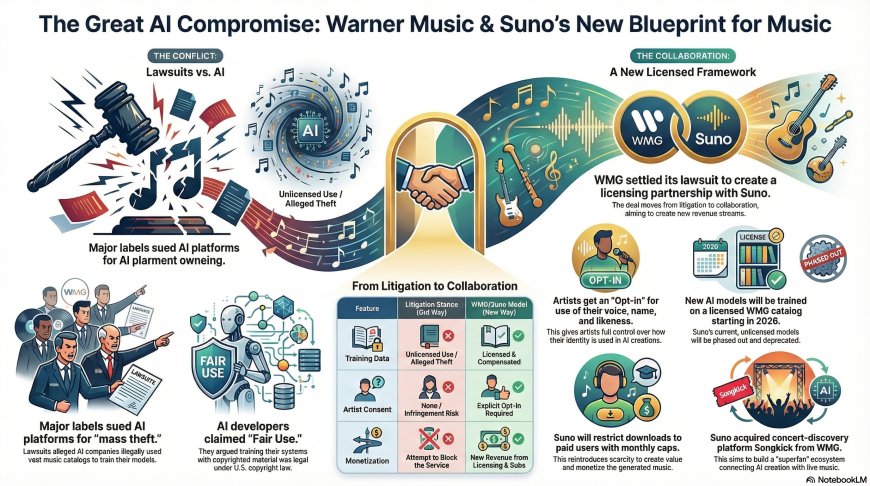
For the past year, WMG, alongside Universal Music Group (UMG) and Sony Music Group, had been embroiled in lawsuits against Suno and its competitor Udio, alleging the mass, unauthorized mining of copyrighted recordings to train models that threaten to devalue human artistry.
The WMG-Suno settlement resolves these legal claims and is considered one of the first large-scale frameworks for licensed AI music generation. Crucially, the agreement establishes a direct licensing pipeline that bypasses the contentious legal debate over "Fair Use" in machine learning by treating model training as a distinct, compensable usage right, similar to mechanical or synchronization royalties.
WMG CEO Robert Kyncl, a veteran of navigating content disputes with technology platforms, emphasized that AI becomes "pro-artist" when it adheres to specific principles, including "committing to licensed models" and providing creators with control.
Artist Control and the Mandatory Opt-In
A core component of the WMG-Suno blueprint is the explicit focus on creator protection, addressing major industry concerns about unauthorized deepfake songs and voice cloning.
The agreement mandates an explicit opt-in mechanism for artists and songwriters. WMG artists, who include major acts like Coldplay, Ed Sheeran, Lady Gaga, and The Weeknd, will have full control over whether and how their names, images, likenesses, voices, and compositions (NIL/VC) are used in new AI-generated music.
This consent mechanism serves a dual purpose: it acts as a necessary legal shield for both WMG and Suno against future Right of Publicity lawsuits, while also creating a premium licensed content pool that drives subscription uptake. Artists who opt in stand to benefit from new revenue streams tied to these creation experiences.
Operational Changes and Monetization
To transition to this licensed framework, Suno is implementing profound changes to its platform, set to take effect in 2026:
- Licensed Models: Suno will launch new, more advanced AI models trained exclusively on legitimately licensed WMG content. Its current, unlicensed models will be deprecated when the new versions arrive.
- Download Restrictions: To curb the flood of uncompensated AI-generated content appearing on streaming services and to monetize scarcity, the ability to download audio will be restricted. Downloading audio will require a paid account.
- Tiered Access: Songs created on the free tier will only be playable and shareable, but not downloadable. Paid users will also face limited monthly download caps, with the option to purchase additional downloads.
This monetization strategy is designed to counteract the fundamental economic challenge of generative AI—the creation of infinite, low-cost content—by artificially reintroducing scarcity through utility controls.
Beyond Creation: The Superfan Ecosystem
Adding an intriguing dimension to the partnership, Suno acquired Songkick, WMG's live music and concert-discovery platform, as part of the deal. Songkick, which tracks artists across millions of concerts globally and has 15 million users, will continue to operate as a fan destination.
This acquisition signals Suno's strategic pivot toward becoming a full-spectrum "superfan" platform. By combining AI creation tools (what music people want to create) with live discovery (which shows they plan to attend), Suno gains access to behavioral data spanning the entire fan journey. This integration creates a closed loop designed to deepen the artist-fan connection and capture maximum consumer spend from highly engaged users.
Looking Ahead: Pressure and the Global Debate
This landmark pact puts immense competitive pressure on rivals UMG and Sony Music, who are still navigating litigation against Suno and Udio. WMG's early licensing approach validates Suno's business model (which recently secured a $2.45 billion valuation) and establishes a clear market precedent that others may be forced to follow.
The WMG-Suno framework offers a powerful commercial example for policymakers wrestling with AI governance globally, emphasizing the need for legal structures that mandate explicit opt-in consent, transparency, and fair compensation. However, there is a critical need to ensure that this model does not create a two-tiered system where only major rights holders can secure lucrative licensing deals, while independent artists struggle to protect their work and likenesses without expensive litigation.
The current shift in the music industry—where a major label chooses collaboration over confrontation—resembles the decision to put a toll booth on a busy highway rather than fighting a losing battle to close the road entirely. Warner Music Group has recognized that the flow of generative AI music cannot be stopped, so it has focused on ensuring that every piece of content passing through the system carries a ticket price that compensates the human architects who built the foundation..
What's Your Reaction?
 Like
0
Like
0
 Dislike
0
Dislike
0
 Love
0
Love
0
 Funny
0
Funny
0
 Angry
0
Angry
0
 Sad
0
Sad
0
 Wow
0
Wow
0